
Educator quick reference
How HUMAN and HEART work together
HUMAN-HEART is Mike's instructional design framework for AI-resilient teaching. It starts with governance: what policy, privacy, and access allow. Those rules apply throughout, and learners' AI literacy is checked before a HUMAN mode is assigned. HUMAN then asks what the learner must remain responsible for, with five modes: Hone (work independently), Use (direct AI as an intern), Mediate (check and correct), Align (justify within rules), and Navigate (govern the workflow). HUMAN is a set of choices, not a ladder. You choose the mode that fits the outcome. HEART asks how teaching and assessment will reveal that responsibility: highlight the outcome, examine AI vulnerability, assign the HUMAN mode, refocus assessment design, and test for integrity and transference. We do not set the regulatory floor for your context. We help you recognize the one your institution already operates under and design around it. The goal is demonstrated human capability, judgment, and accountability, in courses and assignments where AI reinforces academic integrity rather than eroding it.
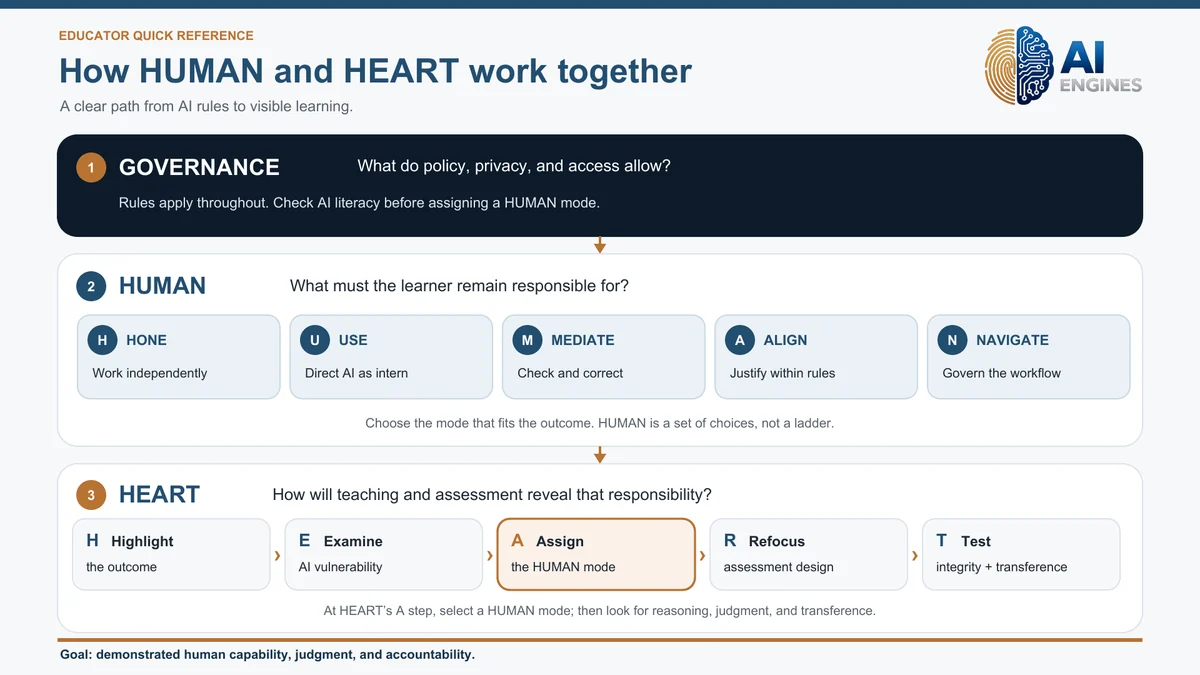
Text version
Educator quick reference
How HUMAN and HEART work together
A clear path from AI rules to visible learning.
1. Governance: what do policy, privacy, and access allow?
Rules apply throughout. Check AI literacy before assigning a HUMAN mode.
2. HUMAN: what must the learner remain responsible for?
- Hone: Work independently
- Use: Direct AI as intern
- Mediate: Check and correct
- Align: Justify within rules
- Navigate: Govern the workflow
Choose the mode that fits the outcome. HUMAN is a set of choices, not a ladder.
3. HEART: how will teaching and assessment reveal that responsibility?
- Highlight the outcome
- Examine AI vulnerability
- Assign the HUMAN mode
- Refocus assessment design
- Test integrity + transference
At HEART's A step, select a HUMAN mode; then look for reasoning, judgment, and transference.
Goal: demonstrated human capability, judgment, and accountability.
1. Governance: what do policy, privacy, and access allow?
Rules apply throughout. Check AI literacy before assigning a HUMAN mode.
2. HUMAN: what must the learner remain responsible for?
-
Hone
Work independently
-
Use
Direct AI as intern
-
Mediate
Check and correct
-
Align
Justify within rules
-
Navigate
Govern the workflow
Choose the mode that fits the outcome. HUMAN is a set of choices, not a ladder.
3. HEART: how will teaching and assessment reveal that responsibility?
-
Highlight
the outcome
-
Examine
AI vulnerability
-
Assign
the HUMAN mode
-
Refocus
assessment design
-
Test
integrity + transference
At HEART's A step, select a HUMAN mode; then look for reasoning, judgment, and transference.
Goal: demonstrated human capability, judgment, and accountability.
HEART lens: Education
Academic integrity. Learning outcome preservation. AI that reinforces what students are meant to demonstrate, never replaces it.
Practical AI for K-12 and higher ed faculty
Regulations that already apply to your work
FERPA. State student privacy laws. District AI-use policy. Institutional academic integrity standards.
We do not set this floor. We help you recognize it and design around it. Read our full AI disclaimer.
A separate custom engagement
HUMAN-HEART is purpose-built for education contexts. It runs as a separate, custom engagement, not as part of the AI Foundations workshop.
See the services page to start a conversation about a HUMAN-HEART engagement for your school, department, or district.